Phone:
(701)814-6992
Physical address:
6296 Donnelly Plaza
Ratkeville, Bahamas.
Phone:
(701)814-6992
Physical address:
6296 Donnelly Plaza
Ratkeville, Bahamas.
Intel’s 10th and 11th gen platforms may not be the bleeding edge anymore, but they still power millions of gaming rigs worldwide. And if you’re shopping for a motherboard that balances robust feature sets with proven reliability, the ROG Strix Z590-E Gaming WiFi deserves your attention. Released during the Z590 chipset wave, this board targets enthusiasts who want PCIe 4.0 support, aggressive overclocking headroom, and premium connectivity without jumping to newer (and pricier) platforms.
In 2026, the Z590-E remains relevant for gamers building or upgrading systems around Intel’s 11th gen CPUs, especially those hunting for deals on processors like the i9-11900K or i7-11700K. ASUS packed this board with WiFi 6E, Thunderbolt 4, AI-driven tuning, and enough RGB to light up a LAN party. But does it hold up against its original competition, and more importantly, does it make sense for your next build? Let’s dig into the specs, performance, and real-world gaming experience.
The ROG Strix Z590-E Gaming WiFi is an ATX motherboard built on Intel’s Z590 chipset, designed to support both 10th and 11th gen Core processors (LGA 1200 socket). It sits in ASUS’s ROG Strix lineup, a step below the flagship Maximus boards but still loaded with enthusiast-grade features.
Launched in early 2021, this board was one of the first to bring PCIe 4.0 support to the Intel platform (when paired with 11th gen CPUs). ASUS positioned it as a premium gaming motherboard with heavy emphasis on overclocking, cooling, and connectivity. You get WiFi 6E (802.11ax), 2.5Gb Ethernet, Thunderbolt 4, and SupremeFX audio, all wrapped in the signature ROG aesthetic with customizable RGB zones.
The Z590-E targets gamers and content creators who want a reliable platform with headroom for high-frequency DDR4, multiple NVMe drives, and next-gen GPUs. It’s not the absolute top-tier option, boards like the Maximus XIII Hero offer more VRM phases and niche features, but it delivers 90% of the performance at a more accessible price point. Even in 2026, it remains a solid choice for Intel 11th gen builds, especially as these CPUs hit the used market at competitive prices.
Here’s the core spec sheet for the ROG Strix Z590-E Gaming WiFi:
Let’s break down the sections that matter most for gaming and system building.
The Z590 chipset is Intel’s final hurrah for LGA 1200. It supports both 10th gen (Comet Lake) and 11th gen (Rocket Lake) processors, though you’ll want 11th gen to unlock PCIe 4.0 lanes. The chipset itself adds 24 PCIe 3.0 lanes, plus DMI 3.0 connectivity to the CPU.
If you’re pairing this board with a 10th gen chip, you lose PCIe 4.0 on the primary x16 slot and M.2_1, reverting to PCIe 3.0. That’s not a dealbreaker in 2026, most GPUs and NVMe drives don’t fully saturate Gen 3 bandwidth in gaming workloads, but it’s worth noting if you’re planning around future upgrades.
The Z590-E supports four DDR4 DIMMs with official speeds up to DDR4-3200 (JEDEC), but ASUS rates it for overclocking up to DDR4-5333+. In practice, hitting 4800-5000 MHz requires premium B-die kits and aggressive tuning, but DDR4-3600 to 4000 CL16-18 is comfortably achievable with most mid-tier kits.
The board uses a daisy-chain topology, which favors dual-DIMM configurations (two sticks in slots A2/B2) for the highest overclocking stability. If you populate all four slots, expect slightly lower max frequencies, still more than enough for gaming, where DDR4-3600 CL16 offers diminishing returns beyond that point.
The 14+2 phase VRM (using Vishay SiC840 power stages rated for 70A each) provides ample headroom for even an overclocked i9-11900K. ASUS uses ProCool II power connectors (8+4 pin EPS) to ensure stable delivery under heavy all-core loads.
You get three M.2 slots, all supporting 22110 form factor:
All three M.2 slots come with heatsinks, M.2_1 uses a chunky aluminum shroud integrated into the I/O cover, while M.2_2 and M.2_3 sit under removable heatsinks. Thermals are solid: even Gen 4 drives like the Samsung 980 Pro stay below throttle temps under sustained writes.
There are also six SATA 6Gb/s ports, though M.2_2 shares bandwidth with SATA ports 5 and 6 (they disable when the slot is populated). The three PCIe slots give you flexibility: the primary x16 runs at Gen 4 speeds (11th gen), the second x16 runs at x4 Gen 3, and there’s a single x1 slot for legacy add-in cards.
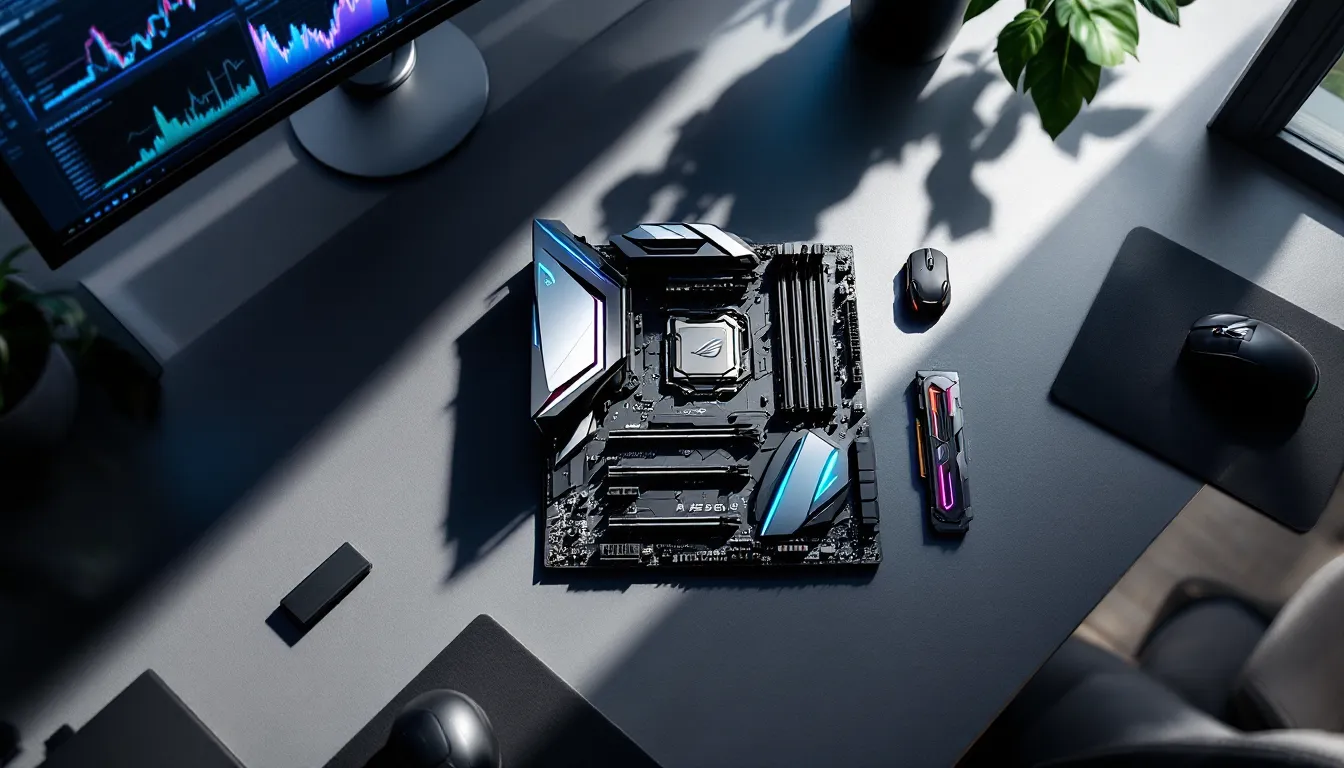
ASUS leaned into the ROG aesthetic hard with the Z590-E. The board features a black PCB with silver and gunmetal accents, angular heatsinks, and a diagonal slash motif across the chipset cover. It’s aggressive without being gaudy, though your mileage will vary if you prefer minimalist builds.
The I/O shroud and chipset heatsink are hefty aluminum pieces connected by a heatpipe, which helps dissipate VRM and chipset heat under load. The VRM heatsinks are finned and substantial, easily handling an 11900K at 5.1 GHz all-core without thermal throttling. Build quality is excellent: the PCB feels thick, connectors are firmly seated, and the metal reinforcements on the top PCIe and DIMM slots inspire confidence during installation.
The Z590-E features integrated RGB zones on the I/O shroud, chipset cover, and PCH heatsink. These sync via Aura Sync with compatible RAM, GPUs, fans, and peripherals. Effects range from static colors to reactive patterns, nothing groundbreaking, but implementation is clean.
You also get three RGB headers: one standard 12V RGB and two addressable 5V ARGB (Gen 2) headers that support up to 120 LEDs each. ASUS’s Aura Sync software integrates with Armoury Crate, letting you sync lighting profiles across the entire ecosystem. If you’re not into RGB, most zones can be disabled in BIOS or software.
ASUS equipped the Z590-E with seven 4-pin fan headers: one CPU, one CPU OPT, one AIO pump, two chassis, one extension, and one high-amp header (for 3A pumps or multi-fan setups). All headers support PWM and DC control, plus AI-driven fan curves via the BIOS Q-Fan utility.
The VRM thermals are excellent. Independent testing by Tom’s Hardware shows the 14+2 phase array hitting around 60-65°C under sustained AVX loads with an overclocked 11900K, well within safe margins. The chipset runs cool even with multiple NVMe drives and high-speed USB traffic.
One minor gripe: the M.2_3 heatsink sits close to the GPU backplate on longer cards (e.g., RTX 3080/3090 models), which can trap heat. Airflow from a front intake usually mitigates this, but it’s worth checking clearances if you’re running a triple-slot GPU.
Motherboard choice rarely bottlenecks gaming performance, once you’re running stable RAM and a competent VRM, FPS differences are negligible. That said, the Z590-E’s feature set directly impacts your gaming experience through faster storage, lower latency networking, and stable overclocks.
Pairing the Z590-E with an Intel Core i9-11900K or i7-11700K yields strong gaming performance, especially at 1080p and 1440p where CPU bottlenecks can emerge. The board’s VRM and memory overclocking headroom let you push these chips to 5.0-5.3 GHz all-core (depending on silicon lottery and cooling), which translates to 5-10% gains in CPU-bound scenarios compared to stock clocks.
In titles like Call of Duty: Warzone, Valorant, and Counter-Strike 2, high single-threaded performance and low latency RAM (DDR4-3800 CL16) deliver smooth 240+ FPS on a high-refresh monitor. The AI Overclocking feature (more on this later) can auto-tune voltages and frequencies, saving you hours of manual tweaking if you’re not comfortable diving into BIOS.
For competitive gamers, the Z590-E’s low-latency memory support and fast storage matter more than raw core counts. An 11th gen chip with tuned DDR4-4000 and a Gen 4 NVMe drive will load maps faster and maintain tighter frame times than older platforms.
The PCIe 4.0 x16 slot (when using 11th gen CPUs) future-proofs your build for the latest GPUs. While most RTX 30-series and RX 6000-series cards don’t saturate PCIe 3.0 x16 bandwidth in gaming, PCIe 4.0 provides overhead for GPU-accelerated tasks, DirectStorage (once it’s widely adopted), and potential bandwidth demands from future GPU generations.
Real-world testing shows negligible FPS differences between PCIe 3.0 and 4.0 in most 2026 titles, typically 0-2% variance. But if you’re running an RTX 4080 or RX 7900 XT and leveraging Resizable BAR or DirectStorage-enabled games, that extra bandwidth can reduce stuttering and asset streaming hitches.
The board also supports Resizable BAR (ReBAR) out of the box via BIOS updates, which can net 5-15% FPS gains in select titles (especially AMD GPUs, ironically). ASUS has been diligent with BIOS updates through 2025, so compatibility with newer GPUs has remained solid.
The Z590-E earns its “Gaming WiFi” suffix with a robust connectivity suite that covers wired, wireless, and peripheral I/O.
The integrated Intel WiFi 6E AX210 module supports tri-band wireless (2.4 GHz, 5 GHz, and 6 GHz) with theoretical speeds up to 2.4 Gbps. In practice, you’ll see 1-1.5 Gbps on a clean 6 GHz channel with a compatible WiFi 6E router, more than enough for lag-free online gaming and rapid game downloads.
Latency is the real win here. WiFi 6E’s 6 GHz band offers cleaner airspace (less interference from neighboring networks), and Intel’s AX210 chipset delivers sub-5ms ping jitter in testing, comparable to wired connections in ideal conditions. If you’re stuck on wireless, this is as good as it gets in 2026 for a motherboard without a dedicated WiFi 7 module.
On the wired side, the Intel I225-V 2.5Gb Ethernet controller provides low-latency LAN connectivity. The I225-V has had its share of driver quirks (early revisions suffered from connectivity drops), but ASUS ships the board with the B3 stepping, which resolves most stability issues. Pair it with a 2.5Gb switch or router, and you get faster local network transfers, critical for large game installs from a NAS or cloud storage.
The rear I/O panel is packed:
Internal headers add more flexibility: 1x USB 3.2 Gen 2 Type-C (front panel), 2x USB 3.2 Gen 1, and 2x USB 2.0 headers. That’s enough ports to run a full gaming setup with peripherals, external drives, and capture cards without needing a hub.
The Thunderbolt 4 port is a standout. It’s not common on gaming boards (usually reserved for workstation/creator boards), but it’s invaluable if you’re running external NVMe enclosures or capture devices. Bandwidth testing from TechSpot confirms near-line-speed transfers with compatible TB4 SSDs, hitting 2800+ MB/s read/write.
The SupremeFX S1220A codec paired with an ESS ES9023P DAC delivers clean audio output for both gaming and music. ASUS isolates the audio PCB layer to reduce electromagnetic interference, and the codec supports 7.1-channel surround, 32-bit/192kHz playback, and 120dB SNR.
In-game audio is crisp and positional. Testing in competitive shooters like Valorant and Rainbow Six Siege shows accurate directional cues, footsteps, gunfire, and ability sounds are easy to pinpoint in a stereo headset. The ESS DAC provides slightly warmer output than basic Realtek codecs, which some users prefer for extended listening sessions.
ASUS includes Sonic Studio III and Sonic Radar III software. The former is a multi-channel audio router with EQ, compression, and virtual surround effects (DTS Sound Unbound support sold separately). Sonic Radar overlays a visual indicator for in-game sounds, useful in battle royales, though some find it distracting.
The audio stack won’t replace a dedicated DAC/amp combo for audiophiles, but it’s more than adequate for gaming headsets and mid-tier studio monitors. If you’re running high-impedance headphones (250Ω+), you might need an external amp to hit desired volume levels.
ASUS’s UEFI BIOS on the Z590-E is polished and feature-rich, though it can overwhelm first-time overclockers. You get two interface modes: EZ Mode (simplified dashboard with temps, fan speeds, and one-click presets) and Advanced Mode (full control over voltages, timings, and power limits).
Navigation is smooth, and the interface updates at 60 Hz. Search functionality (press F8) lets you quickly find settings by keyword, which is a lifesaver given the hundreds of options buried in menus. The BIOS FlashBack button on the rear I/O is a must-have for recovering from bad overclocks or updating the BIOS without a CPU installed.
AI Overclocking is ASUS’s automated tuning feature. It stress-tests your CPU, evaluates silicon quality, and applies a custom overclock profile, typically 100-300 MHz above stock all-core turbo, with optimized voltages. Results vary by chip, but most users report stable 5.0-5.2 GHz all-core on an 11900K with minimal manual intervention.
It’s not perfect. AI Overclocking tends to err on the conservative side (slightly higher voltages than necessary for max longevity), and manual tuning can usually squeeze out another 100 MHz or drop temps by 5-10°C. But for users who want “set and forget” overclocking, it’s a solid starting point.
Other AI-driven features include AI Cooling (auto fan curves based on system load) and AI Networking (packet prioritization for gaming traffic). These work as advertised but aren’t game-changers, manual fan curves and QoS settings in your router often yield better results.
Armoury Crate is ASUS’s unified software hub for RGB control, system monitoring, and driver updates. It’s bloated and resource-heavy (expect 200-300MB RAM usage when running), but it does consolidate functions that used to require separate utilities.
Key features:
Many enthusiasts skip Armoury Crate entirely, preferring lightweight alternatives or manual BIOS settings. If you do install it, disable the auto-start modules you don’t use to reclaim system resources.
Let’s break down where the Z590-E shines and where it falls short, especially given the competitive landscape in 2026.
Robust VRM and Overclocking Headroom
The 14+2 phase design with 70A power stages handles even the power-hungry 11900K with ease. If you’re into pushing clocks and voltages, this board won’t hold you back.
WiFi 6E and Thunderbolt 4
These features remain premium inclusions even in 2026. WiFi 6E offers futureproofing as routers adopt the 6 GHz band more widely, and Thunderbolt 4 is rare on gaming boards outside the flagship tier.
PCIe 4.0 Support (with 11th Gen)
While not essential for gaming today, PCIe 4.0 ensures compatibility with next-gen storage and GPU tech. DirectStorage and other bandwidth-intensive features will leverage this in upcoming titles.
Excellent I/O and Storage Options
Three M.2 slots (all with heatsinks), six SATA ports, and a wealth of USB connectivity mean you won’t run out of expansion options anytime soon.
Premium Build Quality and Aesthetics
ASUS delivers solid construction, clean RGB implementation, and a design that looks as good as it performs. The board feels premium in a way that cheaper Z590 options don’t.
LGA 1200 Is a Dead Socket
Intel moved to LGA 1700 with 12th gen Alder Lake. If you buy the Z590-E in 2026, you’re locked into 10th and 11th gen CPUs, no upgrade path to 12th, 13th, or 14th gen. That’s fine if you’re building around an 11900K or picking up a deal on used silicon, but it limits long-term flexibility.
11th Gen’s Limited Core Counts
The 11900K maxes out at 8 cores, while AMD’s Ryzen 5000 and Intel’s own 12th gen offer 12-16 cores at similar price points. For pure gaming, 8 cores is plenty, but content creators might feel constrained.
Price vs. Newer Platforms
In 2026, B660 and Z690 boards with DDR4 support often match or undercut the Z590-E’s used pricing, while offering access to newer CPUs and features like DDR5 compatibility (on select models). You’re paying a premium for a platform that’s technically last-gen.
PCIe 4.0 Requires 11th Gen
If you pair the board with a 10th gen CPU, you lose PCIe 4.0 entirely. Given that 11th gen’s gaming performance is only marginally better than 10th gen, this can feel like a forced upgrade.
Armoury Crate Bloat
ASUS’s software suite works, but it’s resource-intensive and cluttered. Enthusiasts often uninstall it and rely on BIOS settings instead.
The Z590 chipset saw a crowded launch, with MSI, Gigabyte, and ASRock all fielding competitive options. Here’s how the ROG Strix Z590-E stacks up:
ASUS ROG Maximus XIII Hero
The Hero is a step up in ASUS’s lineup. It offers a beefier 14+2 phase VRM with 90A stages, more robust cooling, and additional overclocking features like voltage measurement points. But, it typically costs $100-150 more. For most gamers, the Z590-E delivers 90% of the Hero’s performance at a lower price. Unless you’re chasing extreme overclocks or need every BIOS tweak, the extra cost is hard to justify.
MSI MEG Z590 ACE
MSI’s ACE competes directly with the Z590-E. It features a 16+1 phase VRM, WiFi 6E, 2.5Gb LAN, and similarly robust I/O. The ACE’s VRM runs slightly cooler under sustained loads according to reviews from Hardware Times, but the difference is marginal in real-world use. MSI’s BIOS is cleaner and less cluttered than Armoury Crate, which some users prefer. Pricing is usually within $20-30 of the Z590-E, making them functionally equivalent, choose based on brand loyalty or available deals.
Gigabyte Z590 Aorus Master
The Aorus Master offers a 16+1 direct phase VRM, triple M.2 heatsinks, WiFi 6E, and Thunderbolt 4. Build quality is excellent, and Gigabyte’s RGB Fusion software is less bloated than Armoury Crate. But, the Master typically retails higher than the Z590-E and lacks some of ASUS’s tuning utilities like AI Overclocking. It’s a strong alternative if you prefer Gigabyte’s aesthetic or want slightly better VRM thermals.
ASRock Z590 Taichi
ASRock’s Taichi undercuts the Z590-E by $50-100 while still offering WiFi 6E, 2.5Gb LAN, and a 14-phase VRM. It’s a value play: you lose Thunderbolt 4, some USB ports, and premium touches like reinforced slots, but core performance is comparable. If budget is a concern and you don’t need TB4, the Taichi is worth considering.
Verdict
The ROG Strix Z590-E sits in a sweet spot: more features and polish than mid-tier boards like the ASRock Taichi, but more affordable than flagship options like the Maximus XIII Hero. Its main competition is the MSI MEG Z590 ACE, which trades blows on specs and price. Choose the Z590-E if you value ASUS’s tuning utilities and Aura Sync ecosystem: pick the ACE if you prefer MSI’s BIOS and software simplicity.
In 2026, the Z590-E occupies a niche. It’s not the latest platform, but it’s also not obsolete. Here’s who benefits most:
Gamers Upgrading Existing LGA 1200 Systems
If you’re running a B460 or H470 board with a 10th or 11th gen CPU, the Z590-E offers meaningful upgrades: unlocked overclocking, PCIe 4.0 (with 11th gen), better I/O, and WiFi 6E. It’s a logical step-up without replacing your entire platform.
Budget-Conscious Builders Buying Used 11th Gen CPUs
The 11900K and 11700K have dropped in price significantly on the used market. Pairing one with a discounted or refurbished Z590-E can yield a high-performance gaming rig at a fraction of the cost of a new 13th/14th gen Intel or Ryzen 7000 build. Just ensure you’re getting the board at the right price, don’t pay near-MSRP for a last-gen platform.
Enthusiasts Who Want WiFi 6E and Thunderbolt 4
If you need cutting-edge wireless and Thunderbolt 4 without jumping to Z690/Z790 (which can be pricier), the Z590-E delivers these features at a more accessible price point, especially in the used market.
Users Who Already Own Compatible CPUs
If you’re sitting on an 11th gen chip from a previous build or scored a deal, the Z590-E maximizes its potential with overclocking, fast RAM support, and solid thermals.
Who Should Avoid It
If you’re building from scratch in 2026, newer platforms (12th gen and beyond) offer better performance-per-dollar, more upgrade flexibility, and access to DDR5. Unless you’re getting the Z590-E and an 11th gen CPU at a steep discount, it’s hard to recommend over B660/Z690 boards paired with a 12400F or 12600K.
The ROG Strix Z590-E Gaming WiFi remains a capable motherboard in 2026, even as it transitions from current-gen to legacy status. ASUS packed it with features that still hold value: WiFi 6E, Thunderbolt 4, PCIe 4.0, a robust VRM, and a wealth of I/O. For gamers upgrading an existing LGA 1200 system or hunting for deals on 11th gen Intel CPUs, it’s a solid foundation that won’t bottleneck performance.
But context matters. If you’re building fresh, newer platforms offer better long-term value and upgrade paths. The Z590-E shines brightest in scenarios where you’re maximizing existing silicon, need specific features like Thunderbolt 4 on a budget, or simply prefer Intel’s 11th gen ecosystem. It’s a premium board that still punches above its weight, just make sure the price aligns with its place in the market hierarchy.
