Phone:
(701)814-6992
Physical address:
6296 Donnelly Plaza
Ratkeville, Bahamas.

Phone:
(701)814-6992
Physical address:
6296 Donnelly Plaza
Ratkeville, Bahamas.
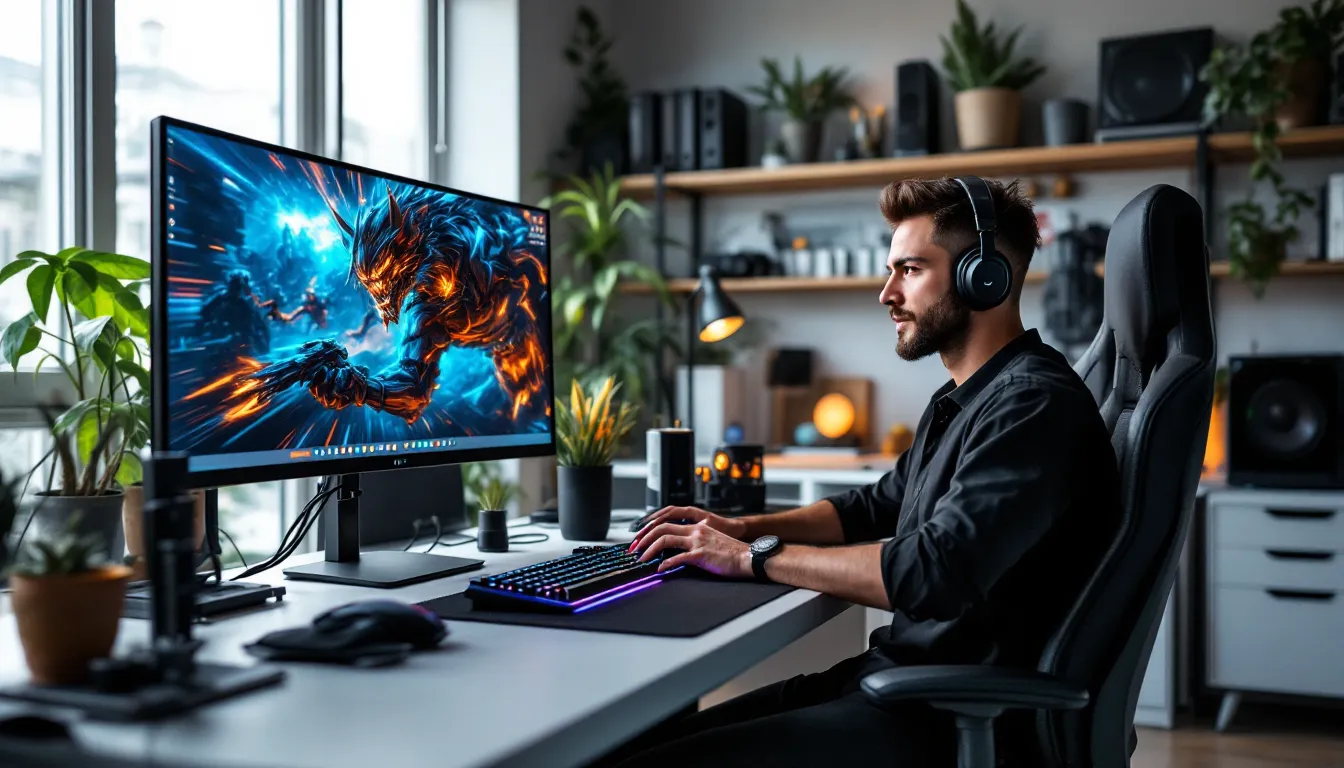
Dropping frames in the middle of a clutch 1v1. Ghosting that makes tracking enemies feel like aiming through fog. A display that bottlenecks your shiny new GPU. Your monitor isn’t just a screen, it’s the interface between your skill and the game world, and a bad one will sabotage your performance before you even queue up.
In 2026, the gaming monitor market is packed with options at every price point, from budget 1080p panels to bleeding-edge 4K OLED displays pushing 480Hz. Whether you’re grinding ranked in competitive shooters, exploring open-world RPGs, or streaming your gameplay, the right monitor can elevate your experience while the wrong one leaves performance on the table. This guide breaks down exactly what to look for in a gaming monitor, cutting through the marketing jargon to focus on specs that actually matter for your setup and playstyle.
Most gamers obsess over GPUs, CPUs, and RAM while treating their monitor as an afterthought. That’s backwards. Your hardware renders frames, but your monitor is what actually delivers them to your eyes. A high-end RTX 5090 paired with a 60Hz display is like putting race fuel in a minivan, you’re wasting potential.
The monitor determines your maximum refresh rate, response time, input lag, and visual fidelity. It’s the final link in the chain, and it can’t be upgraded with a driver update or settings tweak. You’re stuck with what you buy for years.
Competitive players know this instinctively. There’s a reason pro CS2 and Valorant players run 240Hz+ panels even when their peripheral vision barely registers the difference, every millisecond of latency reduction and motion clarity improvement creates a measurable edge. But even if you’re not chasing leaderboards, a better monitor makes games more enjoyable. Smoother motion, sharper images, and more vibrant colors aren’t just luxury features. They’re the difference between feeling connected to the game and watching it through a window.
Beyond specs, your monitor also shapes your ergonomic setup, desk space, and even power consumption. Ultrawide panels demand more GPU horsepower. 4K displays at high refresh rates require specific connectivity. And panel technology determines whether you’re getting accurate colors for content creation or the fastest response times for esports titles. Getting this purchase right means understanding how each spec impacts your specific gaming priorities.
Refresh rate measures how many times per second your monitor updates its image, expressed in hertz (Hz). A 144Hz display refreshes 144 times per second, meaning it can show up to 144 FPS if your system can push them. This is the single most noticeable upgrade from a standard 60Hz display, everything from mouse movement to camera panning feels dramatically smoother.
Higher refresh rates reduce perceived latency because frames are displayed sooner after being rendered. The gap between a frame being ready and appearing on screen shrinks from 16.7ms at 60Hz to 6.9ms at 144Hz and just 4.2ms at 240Hz. For fast-paced games where reaction time matters, that adds up.
60Hz is the baseline standard, found on budget monitors and most TVs. It’s adequate for single-player games and slower genres, but once you’ve experienced higher refresh rates, going back feels choppy. Not recommended for gaming in 2026 unless budget is severely constrained.
144Hz is the sweet spot for most gamers. The jump from 60Hz to 144Hz is enormous, immediately noticeable and impactful across every genre. Modern mid-range GPUs like the RTX 5060 or RX 8700 XT can maintain 144+ FPS at 1080p or 1440p in most titles with reasonable settings. This is the minimum target for anyone serious about PC gaming.
240Hz offers diminishing returns compared to the 60-to-144Hz leap, but competitive players swear by it. The improvement is subtle, smoother tracking, slightly clearer motion, but measurable in fast shooters and MOBAs. You need serious GPU horsepower to consistently hit 240 FPS, especially at 1440p. Testing from Tom’s Hardware confirms that beyond 240Hz, most players struggle to perceive additional smoothness in blind tests, though latency continues to drop.
360Hz and 480Hz panels now exist for the esports elite and hardware enthusiasts. At this tier, you’re paying a premium for microscopic improvements. Unless you’re competing at a high level in games like CS2, Valorant, or Apex Legends, and your system can reliably push 300+ FPS, the cost doesn’t justify the benefit.
Your ideal refresh rate depends on what you play and what your GPU can realistically handle. Competitive FPS and fighting game players benefit most from high refresh rates, 240Hz or higher if the budget allows. MOBA, RTS, and battle royale players see meaningful gains at 144-165Hz. For single-player RPGs, action-adventure games, and story-driven titles, 144Hz is plenty: you’re better off investing in resolution or panel quality.
Console gamers on PS5 or Xbox Series X are capped at 120Hz output, so a 144Hz monitor with HDMI 2.1 support is the ceiling. Don’t overspend on a 240Hz panel for console gaming, you physically can’t use it.
Make sure your system can feed the monitor. A 240Hz display running at 90 FPS feels worse than a 144Hz panel running at its full rate due to frame pacing issues. Check benchmarks for your GPU and target games before committing to ultra-high refresh rates.
Response time and input lag are often confused but measure different things. Response time is how quickly a pixel can change from one color to another, measured in milliseconds. Input lag is the delay between your input (mouse click, button press) and the corresponding action appearing on screen.
Fast response times reduce motion blur and ghosting, the trailing artifacts you see when objects move quickly across the screen. Slow response times make tracking moving targets harder and create a smeared, unclear image during fast camera movement. For competitive gaming, you want response times under 5ms, ideally 1-2ms.
Manufacturers list response time using different metrics, which makes comparisons tricky.
GTG (Gray-to-Gray) measures the time for a pixel to transition between shades of gray. This is the most common spec, but manufacturers often cite the best-case scenario (fastest possible transition) rather than average performance. A monitor advertised as “1ms GTG” might average 3-4ms in real-world use.
MPRT (Moving Picture Response Time) measures perceived motion blur rather than pixel transition speed. It accounts for how long a pixel stays illuminated, which affects motion clarity differently than raw GTG. Some monitors use backlight strobing (like ULMB or DyAc) to reduce MPRT at the cost of brightness.
Real-world performance matters more than spec sheets. Independent testing from sites like RTINGS measures actual response times across different transitions and overdrive settings. Many monitors have multiple response time modes, Normal, Fast, Extreme, where the fastest setting introduces inverse ghosting (pixel overshoot artifacts) that looks worse than slower settings.
Input lag is harder to find in official specs because low numbers are expected in gaming monitors. Most modern gaming displays have input lag under 10ms, with many under 5ms. This is negligible for most players. TVs and older monitors can have 30-50ms+ input lag, which is where problems arise. If you’re looking at the best IPS gaming monitor options, you’ll generally find input lag isn’t a concern, panel response time is the bigger variable.
In practice, prioritize reviews with actual response time measurements over advertised specs. A TN panel with true 1ms response beats an IPS advertised as 1ms but actually averaging 4ms with overshoot artifacts.
Resolution determines how many pixels your monitor displays, more pixels mean sharper images but also demand more GPU power. There’s no universally correct choice: the best resolution depends on your GPU, screen size, and whether you prioritize visual fidelity or maximum frame rates.
1080p (1920×1080) remains the most popular gaming resolution, especially for competitive players. It’s easy to drive, allowing mid-range GPUs to hit high refresh rates consistently. Image quality is fine on 24-27″ screens but starts looking soft or pixelated on larger displays. If your priority is hitting 240+ FPS in competitive shooters, or if you’re on a tighter budget, 1080p makes sense. It’s also the best choice for esports-focused builds where frame rate matters more than eye candy.
1440p (2560×1440) is the current sweet spot for most gamers. It offers a noticeable sharpness upgrade over 1080p without the crushing performance hit of 4K. Modern mid-to-high-end GPUs (RTX 5070, RX 8800 XT) can handle 1440p at 144Hz in most games with high settings. Image quality looks excellent on 27″ and 32″ panels. This resolution works well for both competitive gaming and immersive single-player titles, making it the most versatile choice.
4K (3840×2160) delivers stunning clarity and detail, especially on 32″ and larger screens. But the performance cost is steep, 4K has 2.25x the pixels of 1440p. Even top-tier GPUs like the RTX 5090 struggle to maintain 144 FPS at 4K in demanding titles without DLSS or FSR upscaling. 4K is best for gamers who prioritize visual fidelity in single-player games, have the GPU budget to support it, or are willing to use quality upscaling. For competitive play, the frame rate sacrifice usually isn’t worth it.
Pixel density (measured in PPI, pixels per inch) affects perceived sharpness. A 24″ 1080p monitor has roughly the same pixel density as a 32″ 1440p display (~92 PPI). Going bigger at the same resolution spreads pixels further apart, making individual pixels more visible.
1080p looks sharp on 24″, acceptable on 27″, and soft on 32″.
1440p is ideal for 27″ and 32″, with excellent clarity at typical viewing distances.
4K shines on 32″ and larger, where the increased pixel density creates crisp detail even up close.
Sit closer to your monitor than you would to a TV, usually 2-3 feet. At this distance, lower pixel density becomes more apparent. If you’re considering a 32″ display, 1440p is the minimum for acceptable sharpness, while 4K offers a noticeable upgrade. For 27″ and under, 1440p is plenty sharp for most eyes.
The panel type determines your monitor’s color accuracy, viewing angles, contrast ratio, and response time. Each technology involves trade-offs, and there’s no perfect option, just the right fit for your priorities.
TN (Twisted Nematic) panels are the oldest and fastest technology. They offer true 1ms GTG response times and the lowest input lag, which is why they dominated competitive gaming for years. The downsides? Poor viewing angles (colors shift when viewed off-center), weak contrast ratios, and washed-out colors. TN panels have largely fallen out of favor as IPS technology improved, but they’re still the cheapest option for high-refresh 1080p displays. Only consider TN if you’re on an extremely tight budget and exclusively play competitive games where speed matters more than visuals.
IPS (In-Plane Switching) panels offer excellent color accuracy, wide viewing angles, and decent response times. Modern Fast IPS and Nano IPS variants hit 1-2ms GTG, closing the gap with TN panels. IPS is the most versatile choice, good enough for competitive gaming while delivering vibrant colors for single-player games and content creation. The main weakness is contrast ratio: IPS typically maxes out around 1000:1, leading to grayish blacks in dark scenes. IPS glow (a whitish haze in corners when viewing dark content) can also be distracting in dim lighting. For most gamers, IPS is the default choice unless you have specific needs that push you toward VA.
VA (Vertical Alignment) panels split the difference. They offer much better contrast ratios than IPS, 2500:1 to 6000:1, producing deeper blacks and more impactful HDR performance. VA panels excel in darker games and cinematic single-player titles. The catch? Response times are slower, especially in dark-to-dark (black to gray) transitions. This creates black smearing or ghosting in fast-moving dark scenes, which is noticeable in games with quick camera movement. VA works well for immersive gaming in controlled lighting but isn’t ideal for competitive FPS titles.
OLED panels have entered the gaming monitor space in 2025-2026, offering perfect blacks (infinite contrast), instant response times, and stunning color. QD-OLED variants like those in the Alienware AW3423DW deliver the best of all worlds. The downsides are cost (still quite expensive) and potential burn-in risk if you display static UI elements for thousands of hours. OLED is a premium option for gamers with the budget and willingness to manage potential longevity concerns.
Competitive players prioritize speed: fast response times, high refresh rates, and low input lag. Visual quality is secondary. For this group, Fast IPS or even TN panels make sense.
Single-player and immersive gamers value color, contrast, and HDR. VA or OLED panels offer the most impactful visuals, even if response times are slightly slower. The difference between 2ms and 5ms response is far less noticeable in a story-driven RPG than in a twitch shooter.
If you do both, grind ranked matches and play AAA single-player titles, IPS is the compromise. You get 90% of TN’s speed and 90% of VA’s contrast, making it the jack-of-all-trades choice.
Adaptive sync technologies eliminate screen tearing and reduce stuttering by syncing your monitor’s refresh rate to your GPU’s output frame rate. Instead of the monitor refreshing at a fixed interval while your GPU pushes frames at variable rates (causing tearing when they misalign), adaptive sync adjusts the refresh rate dynamically.
G-Sync is NVIDIA’s proprietary technology. Original G-Sync monitors include a physical hardware module built by NVIDIA, guaranteeing performance but adding significant cost ($100-200 premium). G-Sync monitors also include a built-in scaler, variable overdrive (adjusts response time overdrive as refresh rate changes), and typically wider VRR (variable refresh rate) ranges.
G-Sync Compatible is NVIDIA’s certification for FreeSync monitors that pass their testing standards. You get adaptive sync with NVIDIA GPUs without the G-Sync premium. Most modern gaming monitors with FreeSync are also G-Sync Compatible, making the distinction less important than it used to be.
FreeSync is AMD’s open standard, supported by most modern gaming monitors at no licensing cost. FreeSync works with AMD GPUs and is also compatible with Xbox Series X/S. Performance varies more widely than G-Sync since there’s no hardware module, implementation quality depends on the manufacturer. FreeSync Premium adds low framerate compensation (LFC) and guarantees at least 120Hz at 1080p.
Which one matters? If you have an NVIDIA GPU, look for either G-Sync or G-Sync Compatible certification. If you have an AMD GPU or game on Xbox, ensure FreeSync support. In practice, the difference between G-Sync and good FreeSync implementations is minimal, both eliminate tearing effectively. Don’t overpay for G-Sync unless you want the absolute best implementation or the monitor offers other features justifying the cost.
Adaptive sync works best when your frame rate stays within the monitor’s VRR range (typically 48Hz to max refresh rate). If you drop below the minimum, LFC kicks in to prevent stuttering by duplicating frames. Make sure the monitor’s VRR range aligns with the frame rates your system can actually deliver in your target games.
HDR (High Dynamic Range) expands the range of brightness and color your monitor can display, creating more realistic lighting and vibrant colors. Good HDR makes highlights pop, shadows retain detail, and colors look richer. Bad HDR is worse than no HDR, a marketing checkbox that adds nothing or even degrades image quality.
Most budget and mid-range gaming monitors claim HDR support but lack the hardware to deliver meaningful improvements. True HDR requires high peak brightness (at least 400 nits, ideally 600-1000+), local dimming zones to control backlight independently in different screen areas, and wide color gamut coverage (90%+ DCI-P3).
VESA DisplayHDR certifications provide a baseline for HDR performance, but not all tiers are worth it.
DisplayHDR 400 is the entry level, 400 nits peak brightness, no local dimming required. The HDR effect is barely noticeable, often just slightly brighter SDR. Skip monitors with only HDR 400 certification unless they’re priced as SDR displays and you’re not paying extra for the HDR label.
DisplayHDR 600 requires 600 nits peak brightness and local dimming. This is where HDR starts becoming worthwhile, though the impact varies based on local dimming zone count. More zones mean better control and less blooming (halo effect around bright objects on dark backgrounds). Comprehensive testing from TechRadar shows that DisplayHDR 600 monitors with 32+ zones deliver a noticeable upgrade in supported games.
DisplayHDR 1000 demands 1000 nits peak brightness and robust local dimming. Monitors at this tier offer compelling HDR that genuinely enhances gameplay in supported titles. Expect to pay a premium, these are high-end displays.
OLED panels deliver perfect HDR because each pixel emits its own light (per-pixel local dimming). Infinite contrast, perfect blacks, and instant response make OLED the best HDR gaming experience available, though burn-in risk and cost remain factors.
For HDR to matter, you also need games that support it well. Many titles have poor HDR implementations or require extensive calibration. Windows 11 has improved HDR support compared to Windows 10, but it’s still not seamless. If most of your gaming library doesn’t support HDR or you play competitive games with HDR disabled (common in esports), paying extra for HDR capability may not be worth it.
Color gamut coverage matters beyond HDR. Look for monitors covering at least 95% of sRGB (standard for most content) and ideally 90%+ DCI-P3 (wider gamut used in HDR and modern games). IPS and OLED panels typically offer the best color coverage, while TN and some VA panels fall short.
Screen size and aspect ratio shape your immersion, peripheral vision, and desk space requirements. Bigger isn’t always better, there’s a point where a display becomes unwieldy for gaming, forcing excessive head movement to track information across the screen.
24″ is the traditional esports size. The entire screen fits comfortably in your field of view, allowing you to track all HUD elements and action without moving your eyes far. Most pro players in CS2, Valorant, and League still use 24″ panels. The compact footprint also leaves desk space for large mouse movements. Pair 24″ with 1080p for sharp image quality.
27″ is the most popular size for general gaming. It offers more screen real estate for immersive titles while remaining manageable for competitive play. 27″ works well with 1440p, providing excellent pixel density. This size strikes a good balance for gamers who play a mix of genres.
32″ increases immersion but requires more head movement in fast-paced games. It’s better suited for single-player, RPG, and simulation titles where you’re not constantly scanning for threats. 32″ demands 1440p minimum, with 4K being ideal for sharpness. Sit a bit further back (3+ feet) to keep the whole display comfortable to view.
34″ and larger ultrawides are covered below, but standard 16:9 monitors larger than 32″ become impractical for desks. You’d need to sit far enough back that a TV makes more sense.
21:9 ultrawide monitors (typically 34″ at 3440×1440) expand your peripheral vision, wrapping the game world around you. This is fantastic for immersive single-player games, racing sims, and flight sims. The extra horizontal space also benefits productivity, you can run two full-height windows side-by-side without resizing.
For competitive gaming, ultrawide is more controversial. Some games don’t support 21:9 properly, adding black bars or stretching the image. Some esports titles and tournaments disable ultrawide to keep competitive parity. The wider field of view can provide an advantage in games that support it well (like Apex Legends or Escape from Tarkov), but important HUD elements end up in your peripheral vision, requiring more eye movement.
32:9 super ultrawide (like 49″ at 5120×1440) is essentially two 27″ 1440p displays side-by-side with no bezel. It’s incredible for flight sims, racing games, and immersive exploration, but completely overkill for competitive gaming. You’ll need a very deep desk and a powerful GPU to drive the resolution.
Curved monitors reduce the perceived distance to screen edges, improving immersion on larger and ultrawide displays. The curve radius (measured in millimeters, like 1800R or 1000R) indicates how tight the curve is, smaller numbers mean more aggressive curves. For 27″ displays, curvature is optional and subtle. For 32″ and especially ultrawides, a curve improves viewing angles and reduces distortion at screen edges. Most ultrawide gamers prefer 1800R or tighter curves. Flat panels can feel awkward at ultrawide sizes because the edges are significantly further from your eyes than the center.
Consider your desk depth and viewing distance. Larger monitors and aggressive curves require sitting further back to avoid neck strain. Measure your setup before committing to a 34″+ display.
Specs and panel quality matter, but usability features affect your daily experience. Don’t overlook connectivity options and ergonomic adjustments, they determine whether your monitor actually fits your setup.
DisplayPort is the preferred connection for PC gaming. DisplayPort 1.4 supports 1440p at 240Hz and 4K at 120Hz with HDR. DisplayPort 2.1 (starting to appear in 2026 monitors) dramatically increases bandwidth, enabling 4K at 240Hz+ and 8K support. If you’re buying a high-refresh 1440p or 4K monitor, ensure it has DisplayPort 1.4 or newer.
HDMI is necessary for console gaming. HDMI 2.0 tops out at 1080p 240Hz or 1440p 120Hz. HDMI 2.1 is required for 4K 120Hz, which is the maximum output for PS5 and Xbox Series X. If you game on both PC and console, make sure your monitor has at least one HDMI 2.1 port alongside DisplayPort.
USB-C with DisplayPort Alt Mode is increasingly common on premium monitors, allowing video, data, and power delivery through a single cable. This is convenient for laptops and hybrid work-gaming setups but isn’t essential if you’re building a dedicated gaming rig.
USB hub functionality on the monitor adds convenient peripheral connectivity. A built-in USB hub lets you plug your keyboard, mouse, or headset directly into the monitor, reducing cable runs to your PC. It’s a nice-to-have, not a necessity.
Ergonomic adjustments make a huge difference in comfort. Height adjustment is essential, your eyes should naturally align with the top third of the screen. Tilt lets you angle the display to reduce glare. Swivel is helpful if you occasionally turn the monitor to show someone else. Pivot (rotating to portrait orientation) is rarely useful for gaming but handy for productivity.
Cheap monitor stands often offer only tilt, locking you into whatever height the manufacturer chose. If the included stand is limited, budget for a VESA-mount arm, which gives you full adjustment freedom and clears desk space. Most monitors support 75mm or 100mm VESA patterns, but always check specs, some budget models lack VESA mounting entirely.
OSD (On-Screen Display) controls vary widely. Physical buttons are fast and tactile. Joystick controls are even better, allowing quick navigation of settings menus. Touch-sensitive buttons are the worst, often requiring multiple presses to register. A good OSD lets you quickly switch between color profiles or enable features like crosshair overlays and FPS counters. Test the OSD in reviews before buying if possible, clunky menu navigation gets old fast.
Your monitor doesn’t exist in isolation, it needs to match your GPU, platform, and the games you actually play. A mismatch here wastes money and performance.
PS5 and Xbox Series X output a maximum of 4K at 120Hz or 1080p at 120Hz. They do not support 1440p natively (though Xbox Series consoles added 1440p support via update). HDMI 2.1 is required to hit 4K 120Hz, older HDMI 2.0 monitors cap out at 4K 60Hz or 1080p 120Hz.
For console gaming, prioritize:
Don’t buy a 240Hz or 1440p native monitor for console gaming unless you also game on PC. Consoles can’t output those specs. A 27″ 1080p 120Hz IPS monitor with HDMI 2.1 is plenty for competitive console gaming, while a 32″ 4K 120Hz display is ideal for single-player titles where fidelity matters.
Your GPU determines what resolution and refresh rate you can realistically target. There’s no point buying a 1440p 240Hz monitor if your GPU struggles to hit 100 FPS in your main games, you’ll never use the full capability.
Here’s a rough pairing guide for 2026 GPUs:
Entry-level GPUs (RTX 5050, RX 8600): 1080p 144Hz is the sweet spot. You’ll hit high refresh rates in esports titles and competitive games while staying above 60 FPS in AAA titles with medium-high settings.
Mid-range GPUs (RTX 5060 Ti, RX 8700 XT): 1440p 144-165Hz is ideal. You can push high frame rates in most games with optimized settings and use DLSS/FSR to boost performance when needed.
High-end GPUs (RTX 5070 Ti, RX 8800 XT): 1440p 240Hz or 4K 144Hz, depending on your priority. Competitive players lean toward 1440p 240Hz for maximum smoothness: single-player gamers prefer 4K 144Hz for visual fidelity.
Flagship GPUs (RTX 5080/5090): 4K 144-240Hz or 1440p 360Hz. At this tier, you have enough power for best-in-class specs. Choose based on whether you prioritize resolution or refresh rate.
Check game-specific benchmarks for your GPU and target titles. A GPU that crushes esports titles at 300 FPS might struggle to maintain 100 FPS in Cyberpunk 2077 at high settings. Match your monitor to the games you play most, not theoretical best-case performance.
Choosing what to look for in a gaming monitor comes down to aligning specs with your hardware, playstyle, and budget. Prioritize refresh rate and response time if you’re grinding competitive ranks. Invest in resolution, panel quality, and HDR if immersive single-player experiences are your focus. And if you do both, IPS panels at 1440p 144Hz offer the best all-around compromise.
Don’t chase specs you can’t use. A 240Hz display paired with a GPU that tops out at 90 FPS wastes money better spent elsewhere. Match your monitor to your actual gaming setup, console limitations, GPU performance, and the titles you play most.
Monitors are long-term investments. Buy the best you can afford within your priority specs, because you’ll be staring at it for the next several years. The right panel elevates every session: the wrong one is a constant reminder of what could’ve been.